
By Josh Hollum
In this issue:
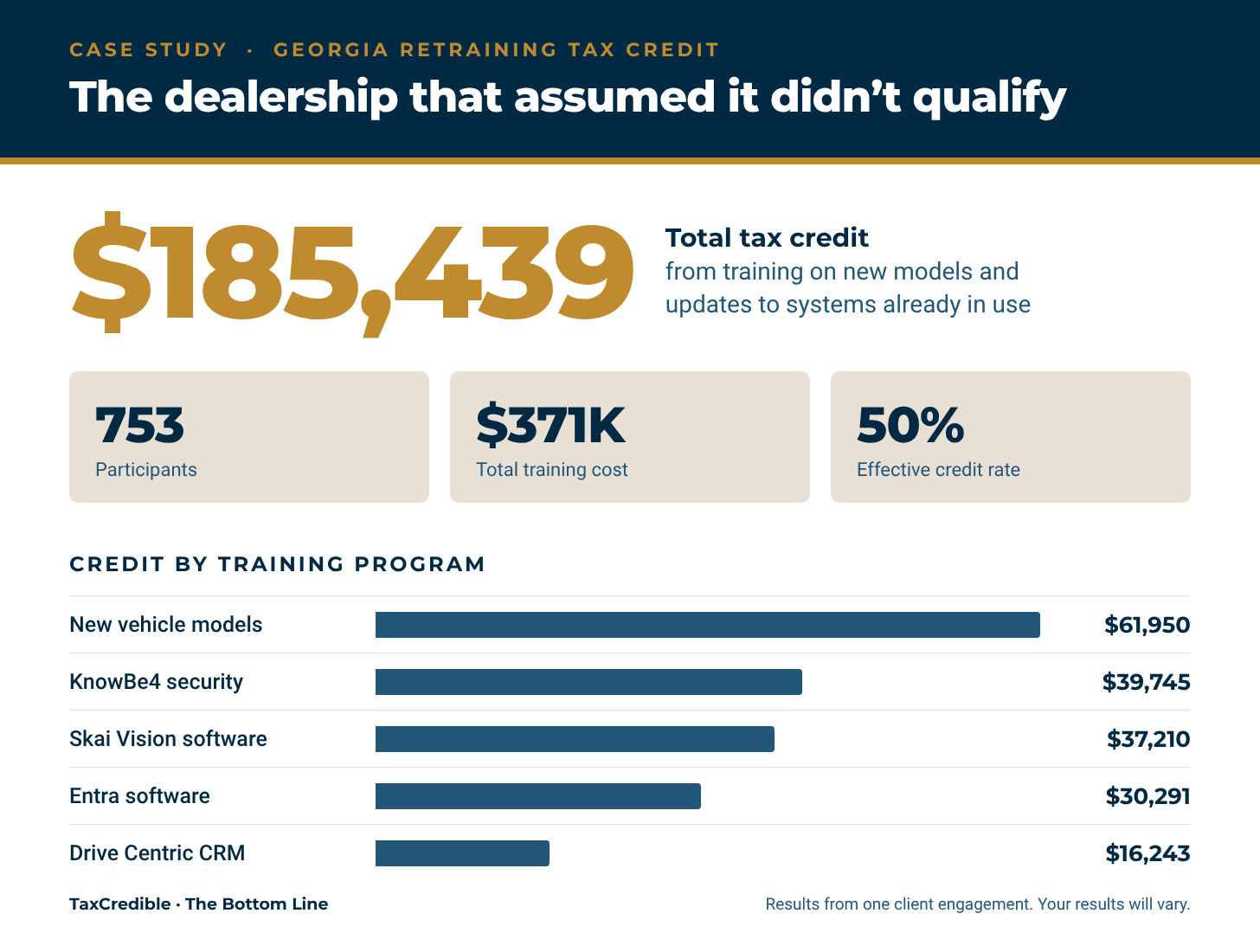
A Georgia auto dealership turned routine software and product training into $185,439 in Georgia Retraining Tax Credits.
New federal rules let businesses deduct domestic research costs right away, but not every R&D project is worth a study.
The Work Opportunity Tax Credit has lapsed for new hires. Keep filing the paperwork anyway.
The Bottom Line is a monthly note from Josh Hollum, Client Development Advisor at TaxCredible, about what we're seeing with clients: credits people miss, rules that changed, and the times a credit isn't worth chasing.
"We haven't done anything new"
That's what the owner of a Georgia auto dealership told me on our first call. He figured tax credits were for companies inventing things, and that ruled him out. I hear some version of that almost every week.
So we asked what his team had spent the year doing. Mostly training. His staff learned the new vehicle models. They sat through vendor updates on software the dealership already used: security awareness, a vehicle inspection system, and the CRM. Nobody thought of it as special.
Georgia's Retraining Tax Credit did. About $371,000 of training across 753 participants came to $185,439 in credits.
What surprised him was that none of the software was new. The updates and new features were, and so was the way his people used them. If your team spent time this year learning a new version of a system you've had for years, that time may count. Ask me and I'll tell you either way.
Sometimes the answer is "not yet"
The federal R&D rules changed in a way that helps a lot of businesses. For tax years beginning after December 31, 2024, domestic research costs can be deducted right away instead of spread over five years. If you still have 2022 to 2024 costs being amortized, you can generally deduct what's left in 2025 or split it across 2025 and 2026. The window for small businesses to amend prior-year returns closed in July 2026, so check with your tax advisor on which option fits.
What the headlines leave out is that not every R&D project is worth a study. Before we recommend one, we look at two things.
First, where the work happens. Development done outside the U.S. doesn't count. We recently met with a software company doing real qualifying work, but its developers were overseas. That alone cut the credit roughly in half.
Second, how much you spend. As a rule of thumb, we look for at least $200,000 in qualifying U.S. R&D costs before a first-year study makes sense. Below that, the fees and your team's hours can eat most of the benefit.
If you're under that line, I'll say so. I'd rather tell you now than have your team pull a year of payroll and project records for a credit that doesn't earn out.
Hiring? Keep filing the paperwork
The Work Opportunity Tax Credit isn't authorized for employees who started work after December 31, 2025, and Congress hasn't renewed it yet. The Department of Labor has told state agencies they can keep reviewing certification requests in the meantime. They just can't approve any unless the credit comes back.
My advice is to keep screening new hires anyway. The form is due within 28 days of someone's start date. If Congress extends the credit back to January, the employers who kept filing are the ones who can claim it.
Why Jed spreads the word
"When your CFO thanks you for making an introduction to TaxCredible because your company just got a tax rebate of over five-figures, it's your duty to spread the word. If you're headquartered in Georgia, and you invest in training employees on new or upgraded technology, software, or equipment, you can claim up to $1,250 per full-time employee per year. Even better, you don't have to lift a finger because TaxCredible handles everything to determine what you are owed."
Jed Fearon, Account Executive, SnapTech, a TaxCredible client and referral partner
One question for you
What did your team spend time learning this year? A new system, an upgrade from an old one, a new piece of equipment? Email me at josh.hollum@taxcredible.com and tell me. It comes straight to me, and I'll tell you whether there's a credit, even if the answer is no. If it's easier to talk, grab a time on my calendar, or see what you may qualify for.
That's the bottom line,
Josh
Josh Hollum
Client Development Advisor, TaxCredible
josh.hollum@taxcredible.com | 404.935.1086
This post is for general informational purposes only and is not tax, legal, accounting, or financial advice. It does not create an advisor-client relationship and should not replace advice from a qualified professional who understands your circumstances. Tax laws and incentive programs change and may vary by jurisdiction. Consult your CPA, tax advisor, or attorney before acting on this information.
Sources: Internal Revenue Service · U.S. Department of Labor · Georgia Department of Revenue