
Your new hires may already be worth thousands in Georgia tax credits.
The Georgia Job Tax Credit pays qualifying businesses between $750 and $4,000 per new job per year for five years. If you have added headcount in Georgia in the last few years and have not claimed it, you are likely leaving real money behind.
What is the Georgia Job Tax Credit?
The Georgia Job Tax Credit is a state income tax incentive created under O.C.G.A. Section 48-7-40 & 48-7-40.1 to encourage business growth and job creation in Georgia. Any qualified business that creates net new full-time jobs above a county-specific threshold is eligible to claim the credit.
The credit amount ranges from $750 - $4,000 per new job annually, based on where the jobs are located in Georgia. Credits are taken over a five-year period beginning in the year the minimum job threshold is met. Any unused credit can be carried forward for up to five years.
One detail that catches businesses off guard: you can capture credit layers going back five years, but you can only amend prior-year returns to claim them. That makes timing important. The sooner you identify a qualifying activity, the more you can recover.
For CPAs: the Georgia Job Tax Credit is available to clients across industries, stacks with other Georgia credits, and qualifies for carry-forward. The documentation and calculation process is manageable with the right system behind it.
Which businesses qualify for the Georgia Job Tax Credit?
To qualify, a business must be engaged in a qualifying industry and must create a minimum number of net new full-time jobs in a single tax year in Georgia. The minimum threshold depends on the county tier where those jobs are located.
Qualifying industries include:
Manufacturing
Telecommunications
Warehousing and distribution
Research and development
Processing (data, information, and software)
Tourism
Broadcasting
Services for elderly individuals and persons with disabilities
Bottom 40 county, Military Zone, or Opportunity Zone in Georgia.
Businesses outside those categories still qualify if they are located in an Opportunity Zone or a Military Zone in Georgia. Location can open the door even when industry type does not.
What counts as a “new job” for the Georgia Job Tax Credit?
A qualifying job is a net-new full-time position working at least 35 hours per week that pays wages above the lowest county average. The job must be at a Georgia business location and must represent a genuine increase in the company’s Georgia workforce, not a replacement hire or a transfer from another location within the state.
How the Georgia Job Tax Credit tier system works
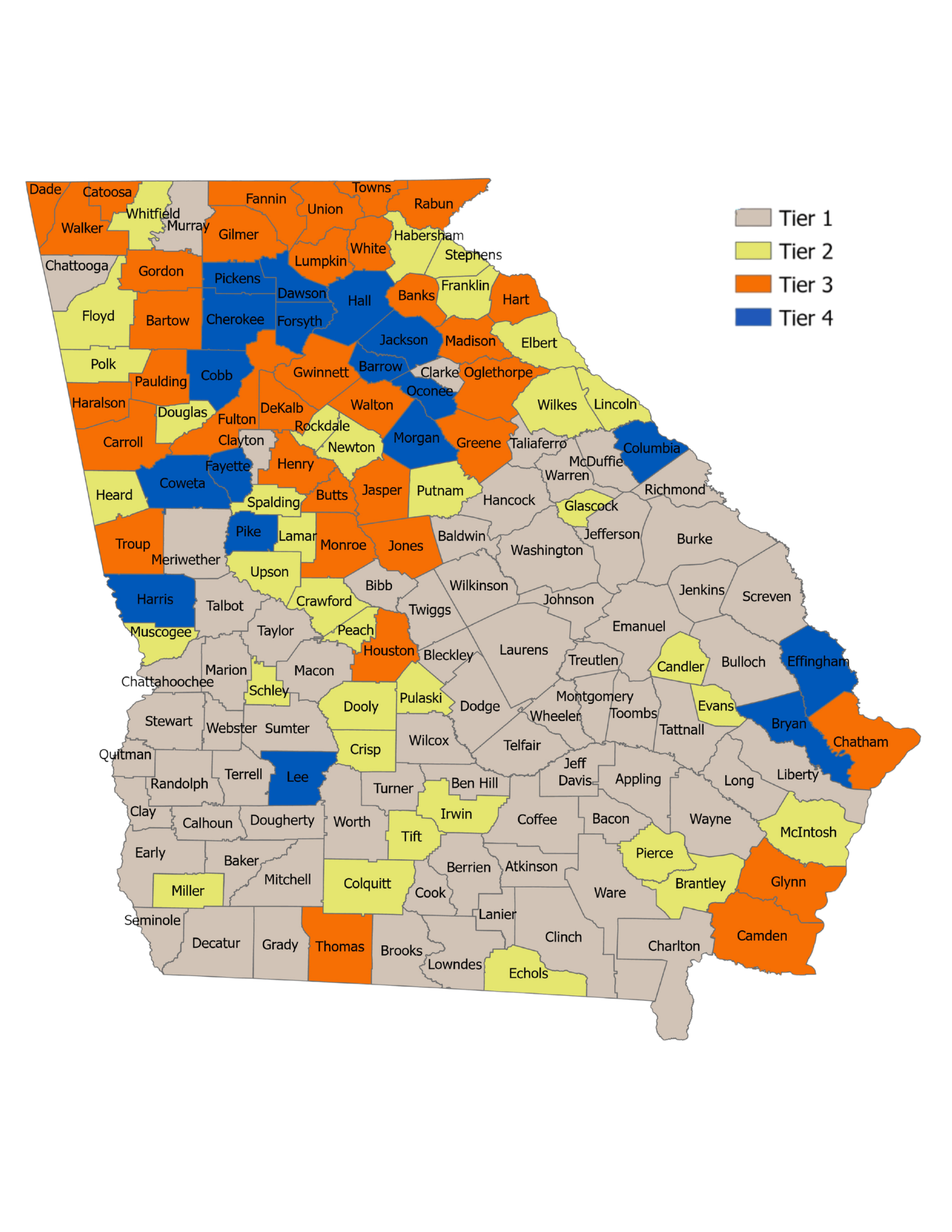
The credit amount and minimum job requirement are both determined by which tier a county falls into. Georgia ranks all 159 counties each year on a four-tier scale based on economic development. Tier 1 counties are the least developed and carry the highest credit. Tier 4 counties are the most developed and carry the lowest.
| Tier | Credit Amount | Minimum Job Growth Required | JDA Bonus Allowed ($500) | Credit Allowance |
|---|---|---|---|---|
| OZ | $3,500 | 2 | No | 100% of tax liability; excess applied to withholding up to $3,500/job |
| MZ | $3,500 | 2 | No | 100% of tax liability; excess applied to withholding up to $3,500/job |
| LDCT | $3,500 | 5 | No | 100% of tax liability; excess applied to withholding up to $3,500/job |
| T1B40 | $3,500 | 2 | Yes | 100% of tax liability; excess applied to withholding up to $3,500/job |
| T1 | $3,500 | 2 | Yes | 100% of tax liability; excess applied to withholding up to $3,500/job |
| T2 | $2,500 | 10 | Yes | 100% of tax liability; excess applied to withholding up to $3,500/job |
| T3 | $1,250 | 15 | Yes | 50% of tax liability; excess applied to withholding up to $3,500/job |
| T4 | $750 | 25 | Yes | 50% of tax liability; excess applied to withholding up to $3,500/job |
Special zones receive Tier 1 treatment regardless of their county's normal classification. These include designated Less Developed Census Tracts (LDCT), Opportunity Zones (OZ), and Military Zones (MZ) in Georgia. Any business type qualifies in an OZ or MZ, which makes location a meaningful credit driver even for businesses that do not fall into a qualifying industry category.
Quick example: A Georgia business creates 50 jobs in a Tier 1 county at $4,000 per job. Over five years, that is $1,000,000 in tax credits.
Tier classifications change annually, so a county that qualified for Tier 1 treatment last year may shift. Capturing the credit in the right year matters.
Why Georgia Job Tax Credits go unclaimed
Most businesses that qualify for the Georgia Job Tax Credit do not realize they qualify. A few reasons come up repeatedly.
First, the industry list is less obvious than it sounds. "Processing" captures software companies. "Services for the elderly" captures assisted living operators. Many business owners in Georgia assume manufacturing is the primary target, look at their own industry, and assume they do not fit.
Second, the tier system changes. A county's classification can shift from year to year, and the credit amounts update alongside it. Without someone tracking those changes, it is easy to miss a year or misapply a rate.
Third, the calculation involves carryforward math across multiple years. If a Georgia business has been adding employees for several years without claiming the credit, there may be multiple stacked credit layers to calculate and claim properly.
TaxCredible handles all of this. We identify whether you qualify, calculate the full credit going back as far as possible, and deliver an audit-ready package your CPA can file.
How to claim the Georgia Job Tax Credit
The credit is claimed on Georgia Form IT-CA, filed with the business's annual Georgia income tax return. There is no pre-certification or advance approval required. The credit is calculated based on documented training costs and the number of employees trained. Here's how TaxCredible approaches it:
1. Identify qualifying job growth
We review your business location(s), census information, and tier designations to determine which year you have a JTC.
2. Document and calculate
We collect the necessary information, run the calculations, and build an audit-ready package showing the job growth at the company.
3. File with your CPA
We prepare everything. Your CPA reviews, and files form IT-CA with your Georgia return. The credit offsets your tax liability and sometimes payroll withholding.
For CPAs managing multiple clients, the process is the same. We integrate with your existing workflow and prepare everything needed for filing. You review and control the final deliverable.
What TaxCredible clients have recovered

A commercial bakery in Georgia recovered $275,000 in Job Tax Credits
A landscaping company qualified for $122,000
A law firm received over $90,000
These businesses had already added headcount in Georgia. The credits were there. They just had not been claimed.
Find out what your job growth in Georgia has already earned.
If your business has added headcount in Georgia, you may have unclaimed Job Tax Credits going back five years. TaxCredible handles the full process, start to finish, alongside your existing CPA.
Frequently Asked Questions
-
You can capture credit layers going back five years. To claim credits from prior years, you must amend the corresponding Georgia income tax return. There is a statute of limitations, so acting quickly matters. TaxCredible can identify the years available to you and prepare the documentation for each one.
-
Tier 1 businesses have a unique advantage: the credit can offset 100% of Georgia income tax liability, and any excess credit can be applied against withholding tax, up to $3,500 per job per year. For Tiers 2 through 4, the credit offsets Georgia income tax liability only, with unused amounts carried forward for up to ten years.
-
Yes. The Georgia Job Tax Credit can be claimed in the same year as the Georgia Investment Tax Credit, the Georgia Retraining Tax Credit, and others. Stacking credits is one of the highest-leverage opportunities for Georgia businesses with qualifying activity across multiple programs.
-
No. Only full-time positions working at least 35 hours per week count toward the minimum job creation requirement for the Georgia Job Tax Credit.
-
The credit amount for a given group of new jobs is locked in at the tier classification for the year those jobs were created in Georgia. Tier changes in subsequent years do not retroactively affect credits already earned, but they do affect new qualifying jobs going forward.
-
Yes. CPAs file Form IT-CA as part of the client's Georgia income tax return. TaxCredible works alongside CPA firms, handling the calculation and documentation so the CPA can review, approve, and file without adding significant work to their process.
-
Possibly. The qualifying industry list is broader than most people expect, and businesses in Georgia Opportunity Zones or Military Zones qualify regardless of industry. The best way to know is to run your business profile against the current eligibility criteria. That is what TaxCredible does in the initial review.
-
The Georgia Job Tax Credit rewards net new job creation. The Georgia Retraining Tax Credit offsets the cost of training existing employees on new technology. The two credits target different activities and can be claimed in the same year if both qualify. Many Georgia businesses with growing headcount and ongoing technology upgrades are eligible for both.